Estimated reading time: 11 minutes
There is an article on Skillshare (https://www.skillshare.com/en/blog/knitting-vs-crochet-which-craft-should-you-learn/) describing the differences between knitting and crochet and when each is appropriate to use. To quote the article, “Since crocheted fabric is typically stiffer and thicker than knit fabric, it’s ideal for projects that benefit from some structure,” which the author goes on to explain means anything that isn’t going to be worn. Wearables, so says this author, are best left to knitters.
As if. Stiff, thick, unwearable fabric is not inherent to crochet. (Please see my “Crochet needs a voice” post if you would like a full discussion of my views on this topic.) You can make crocheted fabric that is fitted, that stretches, and that drapes. The same garment can even do all three. It all comes down to understanding how crochet stitches and hooks work together to create fabric and which yarn is best for which project.
Let’s begin with some thought experiments. Imagine you have a nice, empty sheet of paper just waiting for something wonderful to happen. Holeless as it is, it is closest to an item made out of all one crochet stitch such as singles, half doubles, or even tight doubles crafted with a small hook in relation to the yarn size. This combination gives you a tight, mostly holeless fabric best for amigurumi. There is not much drape and it isn’t overly interesting to look at because it isn’t supposed to be. It’s supposed to be firm and unyielding. I’m not saying it can’t be made to drape, I’m saying there are better ways.
If you were to work a garment made of all single, half double, or double crochets with a bigger hook, you would get more drape (and bigger holes). But this only works to a point because eventually the stitches start to lose their definition and break down in little yarny piles of knotted mess instead of appearing as coherent crochet stitches. Is this a matter of personal preference and choice in the appearance of your project? It absolutely is. If you don’t agree with me, do it your way and many blessings to you and your work. Seriously. We all have our tastes, honor yours.
Back to the thought experiments. Now take that sheet of paper and punch nine dime sized holes in it. This is equivalent to crochet with a medium hook in comparison to yarn size and all one stitch like singles or half doubles. Drape still isn’t really a thing here. There are some holes but they are small and do little to help the project do much but let some air in.
Take a new sheet and punch about nine half dollar sized holes evenly across the paper. (Hello to everyone over the age of about twenty and those below who found a stack of big, weird coins in their parents’ closet or sock drawer. I miss half dollars.) This is the equivalent of any yarn worked with a medium hook for the yarn in question and a more open stitch pattern, though not really open. Clearly, it isn’t as solid as it used to be, but it isn’t completely limp either. A stitch pattern with holes (chains and varied stitches) is going to give some drape even with a big yarn and a smaller hook (big yarn worked with a big hook equals bigger holes when combined with a varied stitch pattern, so a different thought experiment). Let’s do more thought experiments.
From the endless closet of office supplies that lives in your imagination, get yourself another beautifully empty sheet of paper. Instead of punching big holes into this one, imagine you have a needle point tracing wheel. When Amazon sells them, they look like this:

When I was tiny, I found one of these gems in my mother’s sewing supplies and used it for evil in my attempt to perforate everything that would yield to my tool of destruction. Today, in our little thought experiment, we will imagine using it for good purposes only.
Take your sheet of paper and run the wheel of destruction over it in evenly spaced rows about a 1/16th of an inch apart. Now hold the paper up. It’s still not perfectly limp, but it is a lot less stiff. All of the holes in this example might not be even in size to the area of the holes in the earlier experiments, but, being spaced all over the paper and close together, they lend more drape than the larger holes. The paper that is left is holding the holes together, so there isn’t much paper left to be stiff.
This is the equivalent of using smaller yarn, lace to fingering weight, and a more medium sized hook (Somewhere between a 2 mm to a 4 mm with a lace weight yarn and a 3 mm to a 5 mm with fingering weight yarn. You can go larger but the stitches start to lose their coherence.) with an open stitch pattern. The holes are much smaller, but there are a heck of a lot more of them. Holes lend no resistance. Ask my childhood dog who, as a puppy, found the holes dug for our new porch supports. One minute there was a happy puppy running, the next minute there were cries of dismay and ears jumping up and down trying to get out. She was fine but leary of empty spaces after that. We need not be.
Holes equal drape. The greater the holes to yarn ratio, the more drape even with a more hearty yarn or a smaller hook, within reason. A small yarn and an appropriately sized hook lend the greatest possibility for holes simply because you need to work so many stitches with so many holes to cover the area in question. When you create crocheted fabric this way, it’s as if you have just enough fiber to hold the holes together. Created this way, your project cannot help but be dripping with drape. And this makes sense because the stitches modern crochet descended from were born of attempts to make cheaper lace in the 1800s. Lace has holes. It really is innate to lace to be holey and it’s why stiffness (without chemical means of making it so) is not innate to lace. Holes in lace and holes in crochet both mean drape.
So what does this mean for yarn size and hook choice? Throw out the advice on the yarn labels about hook size. They are far too often wrong (based on knitting requirements despite referring to crochet) and following that advice will give you a poor result and a miserable experience. I think it might be a conspiracy to make crocheters turn into knitters. Don’t fall for it! I normally use between a 2 mm and a 4 mm hook for lace weight yarn and a 3 mm and a 6 mm hook for fingering weight yarn. I really don’t use yarns bigger than that very often, but if you keep bumping the numbers up 1 mm for each yarn size you go up you will have a good working range for your hooks.
But you know what they say: Make a swatch. This means washing it and blocking it, too! And then you will know, based on your specific yarn and stitch pattern choice, the proper hook to use to get the best fabric for your project. There is not one answer because crochet is so dependent on the stitching style of each individual crafter. I am a tight crocheter by nature, but also a lifter, meaning the point of my hook goes up after each pull through, thus elongating the loops I make and my stitches. This creates taller stitches than other crafters might get, but it also creates more drape by making longer, thinner stitches.
Let’s look at the next aspect of creating drape in crochet: Fiber choice. Imagine a hank of yarn that has been well twisted into a little yarn log. When you lift it, it holds its shape. Lots of yarns do this, it is neither good nor bad. Now imagine a yarn hank that, despite being tightly twisted into a log shape, just seems to melt when you lift it. That melty yarn is going to give you good drape because it already has drape all on its own. It’s probably silk, alpaca, linen, or some such blend.
You could still make a stiff garment out of such yarn, though. I’ve done it. Just use a tight little stitch like single crochet and a tiny hook, say fingering weight yarn and a 2 mm hook, and you can make that nice drapey yarn into something pretty stiff. (A moment of silence for the arm warmers that could stand up on their own despite being made of fingering weight alpaca. I’m sorry.) Don’t do that. It’s not going to make a nice garment, and no one is going to want to wear it unless they really, really love you and are the sort of person who would do anything, no matter how much they suffered for it, to support you and your craft. Be kind to these people. Make them good things. They are the backbone of your crafting support network.
My very short list of naturally draping natural yarns include silk, linen, mohair, angora (please see note), and alpaca. Moving up the scale of drape, you get merino, BFL, targhee, and other longwool sheep breeds. In the place of least drapey fibers are cotton and hemp. There are others, including the range of synthetic fibers, that I don’t mention here. Go find them and play with them. Tell me what you learn in the comments.
Take your time and play with the different fibers to find the best choice for your projects. If you want a sweater with nice drape, choose a naturally drapey yarn, and you are part way there. Pick an appropriately sized hook, no matter which yarn you choose, and you’re even closer to beautiful drape, but the last choice can still trip you up.
Note: Angora yarn is a luxury yarn if you are getting the good stuff from a good bunny care giver who is giving their buns the best possible life. It is neither for everyone nor for every project. Far too many angora bunnies are mistreated and desperately in need of a hug. If you use this yarn, please find an ethical supplier.
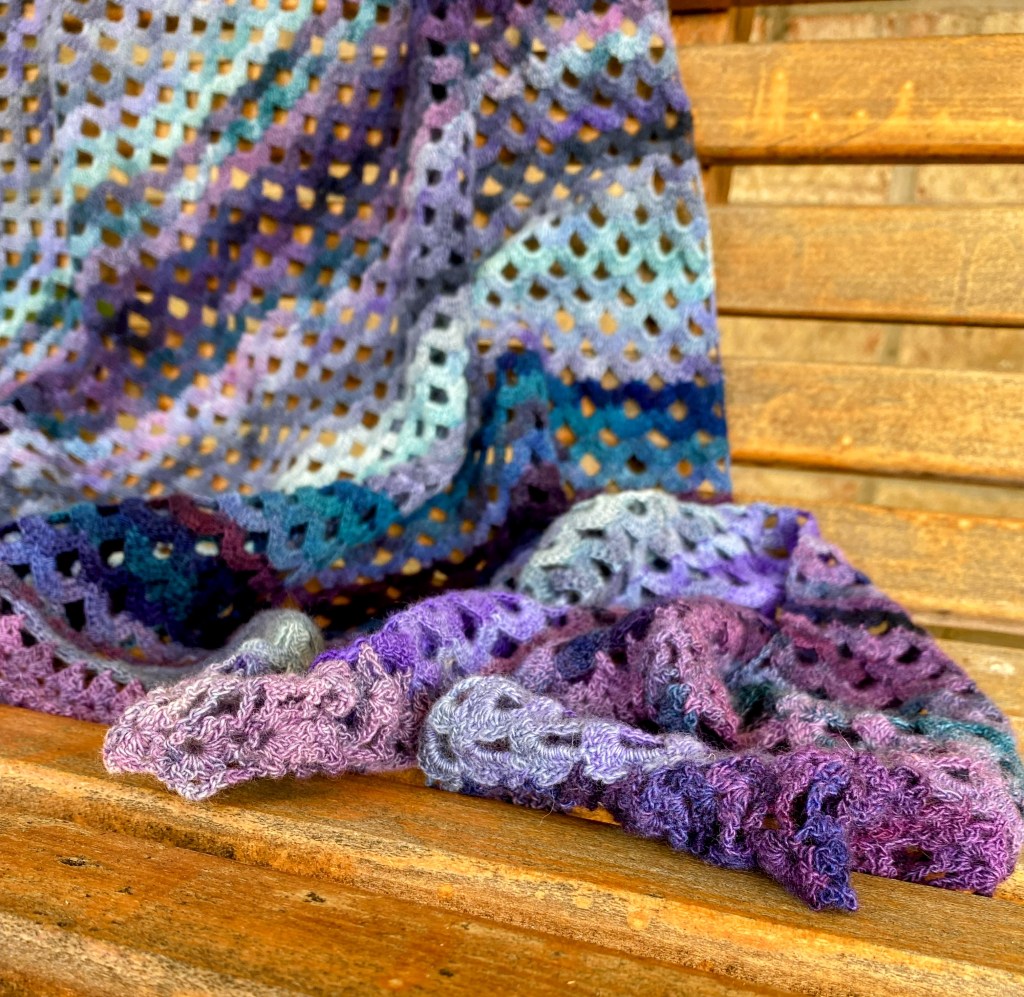
Stitch pattern matters. It matters a whole, whole lot. Remember those holes? This is where the holes come from. A fabric made of all single crochets begets only a few small holes. The same is true of half doubles and doubles, though those do give a bit more drape. The really tall stitches do drape, but they look rather stringy for a whole sweater. If you want to achieve good drape with a crochet stitch, you want something that creates little open spaces between the stitches. In the nothingness of these open spaces, the glory of drape resides! So use those stitches with chains between them! Create arcs and shells and other weird and irregular stitches that leave bits of space around them. They are the key to getting good drape, and they also help with stretch and clinginess, if that’s your thing.
This doesn’t mean that all crochet garments will be revealing and scandalous when worn without something underneath them. Simple moss or linen stitch can give good drape and coverage with the right yarn and hook choice. (In this case, a larger, for the yarn, hook size and a yarn with natural drape will result in a sweater or other garment with drape and some stretch.) It’s the addition of little bits of space that makes drape work. So try out stitch patterns with a few chains and gaps thrown in, you will be pleasantly surprised how much drape you get without needing to worry about indecency.
One more thing, if I know this and can make it work in my crochet, you can do this too. Make swatches. Use the leftover bits of your yarn from projects to work up swatches with different stitch patterns and hook sizes. See what combinations you like. Use those to create awesome garments. To create drape and stretch in crochet you need to experiment a lot with different yarns, hooks, and stitches. Consider it a little course in crochet excellence as you work through various combinations. Your work is going to be better for it!
Together we can show all of the crochet naysayers how good crochet can be.

 Cat Mad Crochet
Leave a comment