Estimated reading time: 16 minutes
Look, we all start our craft journey somewhere. Lots of us start with plastic hooks, inexpensive yarn, scissors borrowed from a child who last used them to cut through a paste heavy paper project, and a free pattern from a yarn band. From here we all evolve into our own ways of working and the materials needed for that work. If you browse the aisles of your local big box store, you are going to find tons of stuff the corporate world would love to make you believe you need to have to crochet well. What you really need to learn and improve your crochet is yarn, some hooks in various sizes and materials, access to different stitch patterns to try out, a lot of time, and a critical eye (yours or someone else’s). The stores cannot sell you all of those things, so they came up with a lot of other stuff to distract you from this fact. If they do ever start selling time, though, I’ll let you know immediately.
In this age of our planet’s slow burn, it has become popular to make videos on any platform that will have them about what you do not need to buy for crochet. These range from trying to be helpful to new crafters to elitist because they don’t buy things and neither should you. I have watched some of them, and I would like to add my opinion to the mix with several items I really do need, and you might too, and why I am very happy to have them.
1 – I need hooks made of more than just metal or plastic
As a beginner, you get attached to whatever hooks you start out with. I was given some plastic hooks in the beginning of my adventure and was ready to use plastic hooks until I died or they did. The thing was, I was murdering them all the time with my super tight stitches. They were never going to last long in my overzealous hands because those plastic hooks were no match for my unyielding crochet stitches. I switched to metal hooks because they could stand up to me.
Eventually, when those tight stitches were clearly becoming a problem, I switched to wooden hooks because I knew I could break them, and they were expensive, so I didn’t want to break them. I had to ease up on my tension to save the hooks. That worked, and I was able to consciously change my tension. I’m still a tighter crocheter than many other people, but it’s much better than it was.
As my skills increased, and I started to use different types of yarn, I learned more about why you need hooks made of different materials. Metal hooks are great for animal based fibers because they are smooth and the yarn slides gracefully over the hook. Wooden hooks are better for slippery fibers like silk or bamboo because they offer some resistance to the yarn and make it easier to manipulate.
As I began to work with a lot of different fibers, I realized that some fibers were just not happy with my hook choices and were determined to let me know. Once I knew there was a reason to use a certain hook with a certain fiber, then I started to try those options and discovered the best choices for me and how I work. But this means I had to try different hooks with different fibers.
You know what that means? We’re back to swatching. Yep. I think swatching is to crochet as tuberculosis is to history: Just when you think it’s not about swatching, it is. When I swatch, I like to try hooks made with different materials as well as different sizes. You might be surprised how much easier some fibers are to work with with one type of hook than another. I deeply wish I had known this when I made a silk wrap with a metal hook. The yarn was beautiful, but I gave the remaining bits away to my daughter after I finished the wrap because the process was so miserable. I didn’t know. Now I do.
2 – I need scissors other than the damn kitchen shears
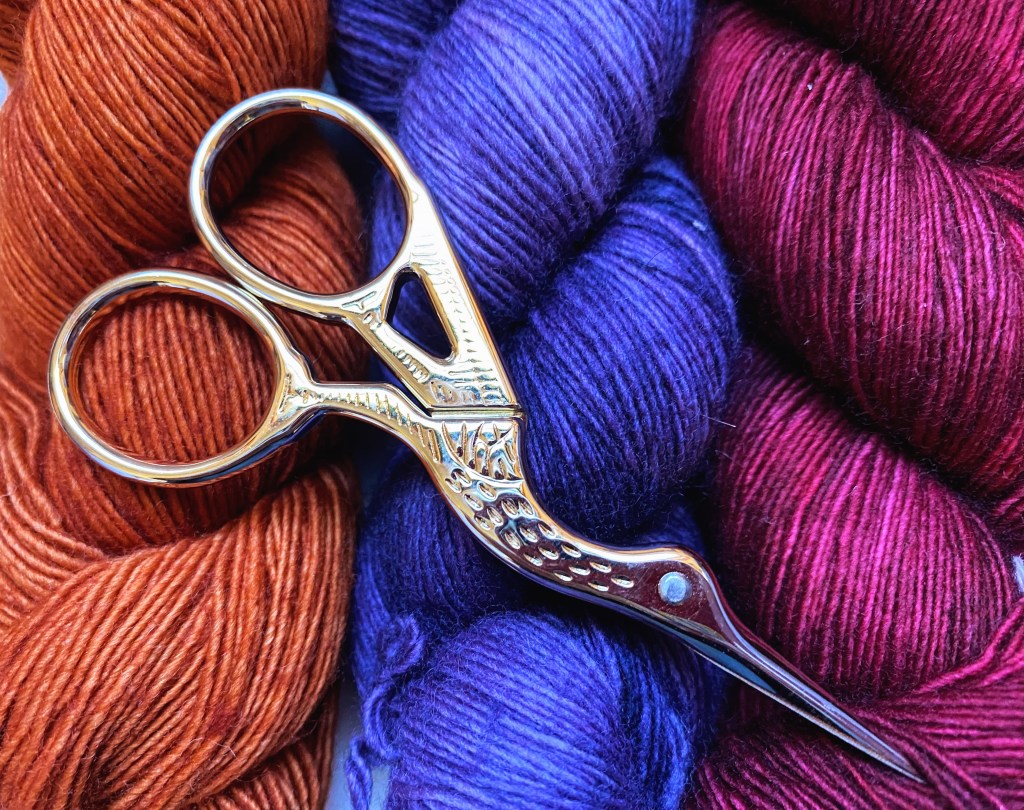
Okay, in watching various videos about must-have crochet tools, the crafters who insisted you only needed big, clunky scissors (and, yes, kitchen shears would do) really upset me. What this normally came down to was a rail against tiny scissors that are sold to crocheters and knitters. The posters point out that you just need to cut the yarn. One crafter, though, had found no need for anything beyond kitchen shears! Dear reader, I had to stop crocheting and give a mini-rant to the poor cat. Turns out, the cat is anti-scissor across the board. Who knew?
Can you imagine taking kitchen shears to a lace project that took you over a hundred hours to complete only to find you caught some fragile bit in the giant scissors and ruined your project? It’s the stuff of nightmares. My palms are sweating and my stomach is unsettling as I write this.
Just no. Do not take kitchen shears to your projects. It’s fair to ask if anyone really needs a $200 pair of handcrafted, gold-plated mini-scissors with a three lifetime guarantee that you can send them back to be expertly sharpened by a team of artisans sixteen generations in the making. Because the answer is probably no, unless of course that’s what makes you happy. Someone has to buy them, or those poor scissor sharpeners will have nothing to do.
For years, I used an inexpensive pair of small scissors. Like a really inexpensive pair. Okay, I took the pairs of safety scissors my children abandoned years ago and used those. Parts of them were very dull. Parts of them still had tape or glue on them, though some of them were washed and clean. I am a bad scissor guardian. I will use the same pair of scissors to cut silk and, minutes later, cardboard. I am not worthy of expensive scissors because I will ruin them. This is why my daughter inherited my grandmother’s good sewing scissors. However, I did get myself an inexpensive pair of little scissors. I am doing my best not to ruin them because I love them.
My point is that I need a pair of scissors dainty enough that I can see exactly what I am cutting when I cut so I can avoid disaster. I work with very thin yarn, so I will need scissors with a fine point so that I cut only what I want to. Tiny scissors allow me this precision. Are they for everyone? No. Are they vital for some people? Absolutely!
3 – I need stitch markers more functional than a piece of yarn
It seems to be some sort of false common wisdom that stitch markers are unnecessary in crochet because you can just pop a bit of yarn in and weave it through your project to mark your place. It isn’t wrong if you are making items with a solid stitch pattern, like single crochet, then you can, in fact, mark spots with a bit of yarn.
But what if you aren’t? What if you are making something with a complex, open, lace stitch pattern? What if the yarn won’t weave through these stitches in a way that keeps it in place? Enter the stitch marker.
Safety pins of all shapes and constructions, lobster claw markers, or, in a pinch, paper clips can all be stitch markers. They make some complex projects possible without tears and profanity, at least for me. These, like scissors, do not have to be fancy. I think I bought 1,000 of those cute little round bottomed safety pin markers for $10 online. This will likely last me a lifetime. They do not have beads, fandom symbols, tiny works of art, or anything else on them. They are plain, round-bottomed safety pins. One could also use standard safety pins if that is what you have on hand, I know I have. I have some of the lobster claw style markers, but I find placing the safety pin style markers is easier for me.
There have been times when I did use some of the beaded markers and the plain markers together. When each marked spot indicates a different action to be taken at that point, having different looking markers is a good idea.
I do not use the plastic markers. The projects I make tend to have very small stitches, and the plastic markers just don’t work well for small stitches. If you work with larger yarns, the plastic stitch markers will likely work just fine, as will all of the others I mentioned.
If you only ever work with simple stitch patterns, perhaps you will never need stitch markers. For me they are invaluable.
4 – I really like to have a yarn baller and a yarn swift
I lived most of my crochet life without a yarn baller in the house. One showed up when Hannah, who was heavy into spinning at the time, bought one so she could ply a spun single with itself. It went very well for her spinning needs and the rest of us could use it if we wanted.
At first, it was like any new toy, and all the yarn found itself neatly balled. Things that had been hand balled into perfectly usable shapes found themselves redone with the yarn baller. The advent of the yarn swift in our house created a fast way to ball yarn as we sucked it off the yarn swift with the yarn baller into perfect cakes. A 45 minute job coaxing 400 plus yards of lace weight yarn into a neat ball and hoping not to tangle it became 15 minutes of quick work with a neat cake at the end and no swearing over knots.
I don’t do that anymore. I like to ball yarn by hand because I can get a feel for the yarn and take note of inconsistencies and flaws. I can remove them as I go if I feel so inclined. I still use the yarn swift because I work with a lot of thin yarns that are sold in hanks. These yarns seem to enjoy tangling and making themselves difficult. A yarn swift takes this power away from them, forcing them to behave and stay in place, even if I have to put the ball down and go do something else. Avoiding this sort of yarny mess is a blessing that I will happily pay for again should my yarn swift fail.
Do I fundamentally need a swift? No. I could ball yarn without it, but it does make the job easier. Do I need a yarn baller? Sometimes. If I have one ball of lace weight yarn that I want to hold double, a yarn baller does give me a nice way to accomplish that feat because I can simultaneously pull from the outside and inside of the ball. Otherwise, I have to carefully weigh two little balls of yarn and hope I got it right. I used to do that before the yarn baller, I could go back to it. I will survive either way. They are both nice to have, though, for their time saving graces.
5 – I need a yarn bowl of some sort
I have four yarn bowls. One holds odds and ends; one holds scrap paper, one holds some snowflakes I made several years ago and still need to weave the ends on; one holds tatting supplies. What do I use to hold my yarn? A bowl from the kitchen.
Here’s the thing: No one really needs a fancy, expensive, yarn bowl in the shape of a chinchilla in which the yarn comes out from between her paws as if she is holding it for you specifically because she loves you and has faith in your skills. What I need is something to keep the yarn from rolling away. I often use a kitchen bowl. They are easy to find, I can fit the bowl size to my yarn ball, and I can have several of them going at once if I need them.
I used to just pull the yarn from whatever bag I had the project in, but I have had too many near disasters with one ball of yarn getting way over excited and grabbing the end of another ball of yarn, bringing it along in some sort of unsolvable knot of their own devising. If I just pop the working ball into a bowl, I’m going to have controlled yarn and no surprises.
Of course, one can buy an expensive bowl if that is what you want. If I find that chinchilla bowl from above, I’ll buy it. I fully support buying from hand crafters and snubbing my nose at industrial production, but you can also use a bowl from your kitchen or pick up a weird, little bowl from a thrift store. Personally, I just need to control my yarn. I am much happier with my working process if pulling up more yarn is not a trial.
6- I like to have blocking mats
Let me begin by saying you do not need blocking mats. However, there are people out there saying you do not need blocking mats because you can just rest your wet project on a plastic bag. Worse yet, some argue for not blocking at all. I need to block my work. My projects are always softer, more supple, fit better, and show off their stitches better after blocking. I don’t need expensive blocking mats to get this effect, but I do need something beyond a plastic bag.
Crochet is ripe with lace stitches. Blocking a lace stitch means you need to help it hold its shape until it is dry and stops thinking about how much it doesn’t want to. If I put my wet project on a plastic bag to dry, it will have nothing to hold onto to hold its shape. I can keep reforming it, but it will be a losing battle.
Enter the blocking mat. I can put my project on it, pin it into place, move it when necessary so the cat doesn’t barf on it, and just wait for it to dry. I own blocking mats. They’re very nice for finishing up projects. That being said, I really just need something heavier than my project that I can pin into.
Instead of store bought mats, some people use a kids’ play mat, some people use towels, some people use the carpet if they don’t have any children or pets or cohabitants who will walk through their project or barf on it. These are all valid means to block your project. It doesn’t need to be expensive, but some means of forcing your project into shape with its stitches well displayed is important. And that is not, and will never be, a plastic bag.
7-For me, a crochet hook gauge is important
This item really could be completely unnecessary for most people, though I do feel I need mine. Well-behaved, gracious hooks have their size marked on them somewhere. This enables you to quickly grab the size you need and get to work. Some hooks, though, are not so socially well brought up. Some hooks run with a sizeless, evasive crowd, and keep their particulars to themselves. If you find yourself in possession of a bunch of these hooks, as I do, a crochet hook gauge will help a lot.
It’s very hard to tell only by looking if a hook is a 3 mm, a 2.75 mm, or a 3.25 mm, even if you are comparing it to other marked hooks. At least it is for me, and this is why I keep a crochet hook gauge. If you get one, it’s sometimes fun to check the marked hooks that you have. Many hooks are parading around pedigrees they don’t deserve.
8 – I absolutely must have end weaving needles
Want to see me purse my lips and avert my eyes and not say anything because I am trying to keep from screaming? Tell me you just crochet over your ends and you think all this talk of end weaving is ridiculous. I, too, once believed this. I made a little bag for Adia out of tiny skeins of fingering weight cotton yarn and crocheted over the ends because there were so many of them and weaving ends is deadly dull work. Day one of that bag’s existence as a finished object, the little ends started diligently unweaving themselves and mocking me. I knew cutting them off was bad because they will just keep unweaving themselves, and I will run out of yarn to snip eventually, not to mention the bag could become unstable. I chose to poke them through to the wrong side of the bag, hope for the best, and never work over my ends again.
Now that I work mostly in lacy stitch patterns, there is not a pretty way to rid myself of ends except to weave them carefully and fully into the stitch matrix. To accomplish this, I have a small array of needles with different sizes of eyes, lengths, sharpnesses, and thicknesses so I can get just the right needle for each project.
You must weave your ends if you want them to stay put, especially if you are using any yarn that is not going to felt those ends into place. So yak, cashmere, non-superwash wools, alpaca, angora, and other animal fibers can be crocheted over to weave the ends if you are careful and the stitch pattern supports it. Acrylic, cotton, linen, bamboo, silk, rayon, superwash wools, and any other non-felting fiber need to have the ends carefully woven in so they stay in place. Sometimes, this means you split the plies and weave each one separately. It’s a pain, but those monsters are so confused they will never find their way out of the labyrinth you’ve stitched them. And isn’t that what we really all want? Trapped monsters?
Feel free to disagree with anything I have said. These are the crochet tools necessary for the way I work. We should all work in our own way with the tools we find most important and helpful to us. If you should find somewhere selling time though, let the rest of us know.

 Cat Mad Crochet
Leave a comment