Estimated reading time: 7 minutes
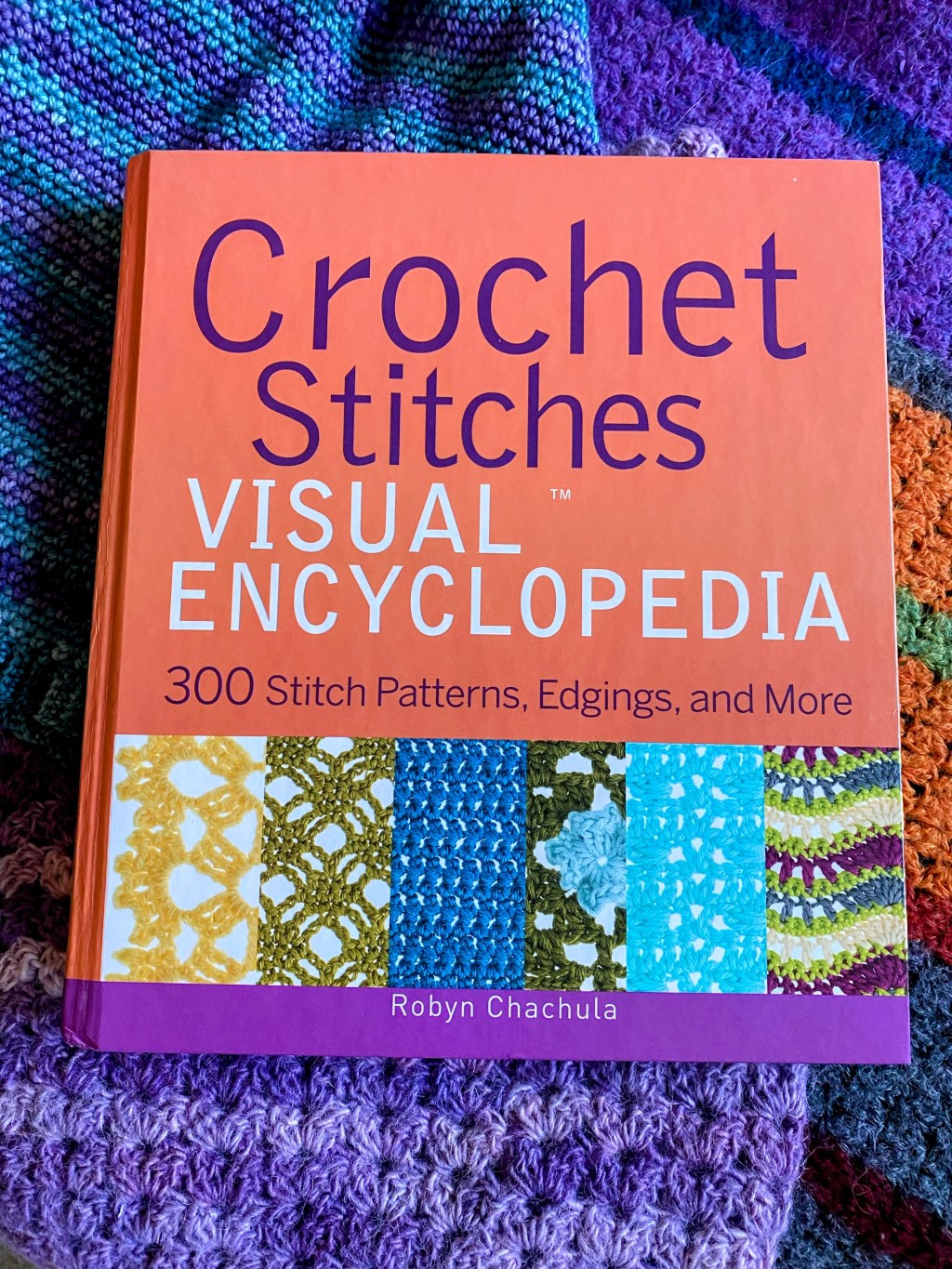
Crochet Stitches Visual Encyclopedia by Robyn Chachula has been one of my favorite stitch dictionaries since I bought it years ago. You know those regularly used books that end up overstuffed with post-it notes, reminders about patterns to try, random receipts living new lives as bookmarks, and pattern notes to yourself? My copy of the Visual Encyclopedia is that book. The spine is getting a little stretched out due to use and my notes. I used this book as an inspirational starter for quite a few projects and continue to look back at it regularly. Let me take you on a little tour of my personal favorite bits.
First a warning: My review is going to be unfair because, of the over 250 pages in this book covering solid and textured stitches, lace, tunisian crochet, motifs, and borders, I routinely only use the first 112 pages of the book. I don’t work on many motif projects and those motifs I do use tend to be really simple (Look! A square!) or found other places (like Pinterest or the odd but useful books on crochet motifs that I seem to be drawn to). I do not do tunisian crochet. I tried once. I found it did not make me happy or curious for more, so I never went back because I had lots of fun things to play with already. The borders I use I either tend to make up to fit the project or they are super simple, like a row or several of single crochets. If you get yourself a copy of this book, please know that it is far richer and better than I am describing.
Under my care, this is a working book. I work with the bits I need. Working books are like that. You use what you need from them, knowing that the other bits can be a resource for someday or never. I can still enjoy the cookbooks I own even though I don’t use the chapters about canning or fermenting foods because sauerkraut makes me gag. Just like tunisian crochet. Just kidding. It’s just not my thing.
So let’s focus on the bits I do use. The book presents a picture of the patterns worked in real yarn in addition to diagrams and notes about the stitch patterns. The pictures show well made and blocked samples using yarns that create clear stitches, so it is very easy to understand what each stitch pattern is going to give you. These aspects alone are great resources, but the author also offers advice on using the various stitch patterns she presents.
When I got this book, I was just starting to try to design my own things. I really wasn’t sure what stitch was good for what project. This book helped me understand that some stitches are going to give you a looser, more flowy fabric while others will be more resilient and thicker. This is very obvious to me now, but back then every little bit of help was a great benefit to me. Her comments on every single stitch pattern presented regarding the uses for the pattern were invaluable to a new crochet crafter.
The first part of the book is dedicated to simple stitches. It begins by demonstrating really simple stitches like single crochet. But it goes beyond that by showing how simple little changes to basic stitches can really jazz up the overall look of a stitch. Add a chain between single crochets and place the next row of stitches into those chains, and you have moss stitch. Versatile little single crochet v stitches are just a hop away and create surprisingly stretchy fabric with good drape. Her examples show off the stitches in such a way that they do not look overly simple at all.
The next section is all about textured stitch patterns. A thousand blessings on the author for going beyond cabling and into overall textured stitches and laces that are actually accomplishable by those of us utterly unable to master cabling. One of the things I love about crochet is the nubby, textured fabric it produces. I love stitches that allow that quality to shine through in post stitches, crossed stitches, combinations of different heights of stitches, and little bits of lace work. This book is wonderful for those sorts of stitches. Some of my favorite stitches to use come from this part of the book and it has the highest number of weird “I need a bookmark now!” bookmarks. There are a fair number of cables, too. I look at them with longing. Someday . . . maybe.
The next section is all about crochet lace patterns. It starts with lace patterns that use shells, puffs, and other interesting bits to create laces with a short repeat sequence that create a really easy rhythm so you can just enjoy the act of making without worrying that watching Bridgerton yet again is going to throw your stitch count off when you get overly involved in the plot. There’s a lot to be said for such a stitch. Being able to learn the basic stitch and then cart the project anywhere and work on it mindlessly while you participate in the rest of life is a joy. It’s like a little productive fidget that you can impress people with. Even if you do nothing beyond make scarves out of these patterns, they will be beautiful and easy to follow along with.
It doesn’t last though. By the end of the chapter, the author takes us into the berry laces and from there to the pineapple laces. I have never tried these laces. When I first started crafting, I was crocheting and minding louder, significantly more active, miniature versions of myself, and I did not have the concentration to work a complex lace and keep my children alive. Now I don’t work with pineapple laces because I am not sure I like them. Something about them says, “Hello! I could be a tablecloth! You could be a 1950s housewife with limited rights and no path out. Do you want to come play?” I, in fact, do not wish to play that game at all. Kidding aside, pineapple lace seems dated to me. It’s complex and I understand it takes a lot of concentration and counting by real numbers in order to accomplish it. It’s just not for me. If it is for you, this book has some interesting variations as well as the original.
The last section that I use, but hardly the last section in the book, concerns unique laces. This is a really dreamy section covering everything from love knots to really interesting flower stitch patterns to others that I have not tried but enjoy looking at. The Brussels stitch patterns look interesting, but I don’t know how I would use them. I think the short row stitch patterns are something I need to play with sometime soon. The Ella stitch really reminds me of a shirt Kyra Nourrice wore on Deep Space Nine. I think I could have good fun trying to recreate that.
Side note, Deep Space Nine is a really nice source of crochet inspiration. They handle layering it really well: Always combine a lace pattern with a more solid pattern for crochet layering brilliance ala the future.
And, sadly, that’s as far as I ever get in this book. The colorwork section is not to my taste and Tunisian crochet makes me grumpy because I do not have the patience to learn it well. The motifs are pretty and I think those might be worth me looking into, so maybe soon I will leap farther back into the book and discover new and wonderful things. The front of the book is getting a bit worn, maybe I should even out the wear.
Happy crocheting!

 Cat Mad Crochet
Leave a comment