Estimated reading time: 10 minutes
Estimated creative inspiration: Incalculable
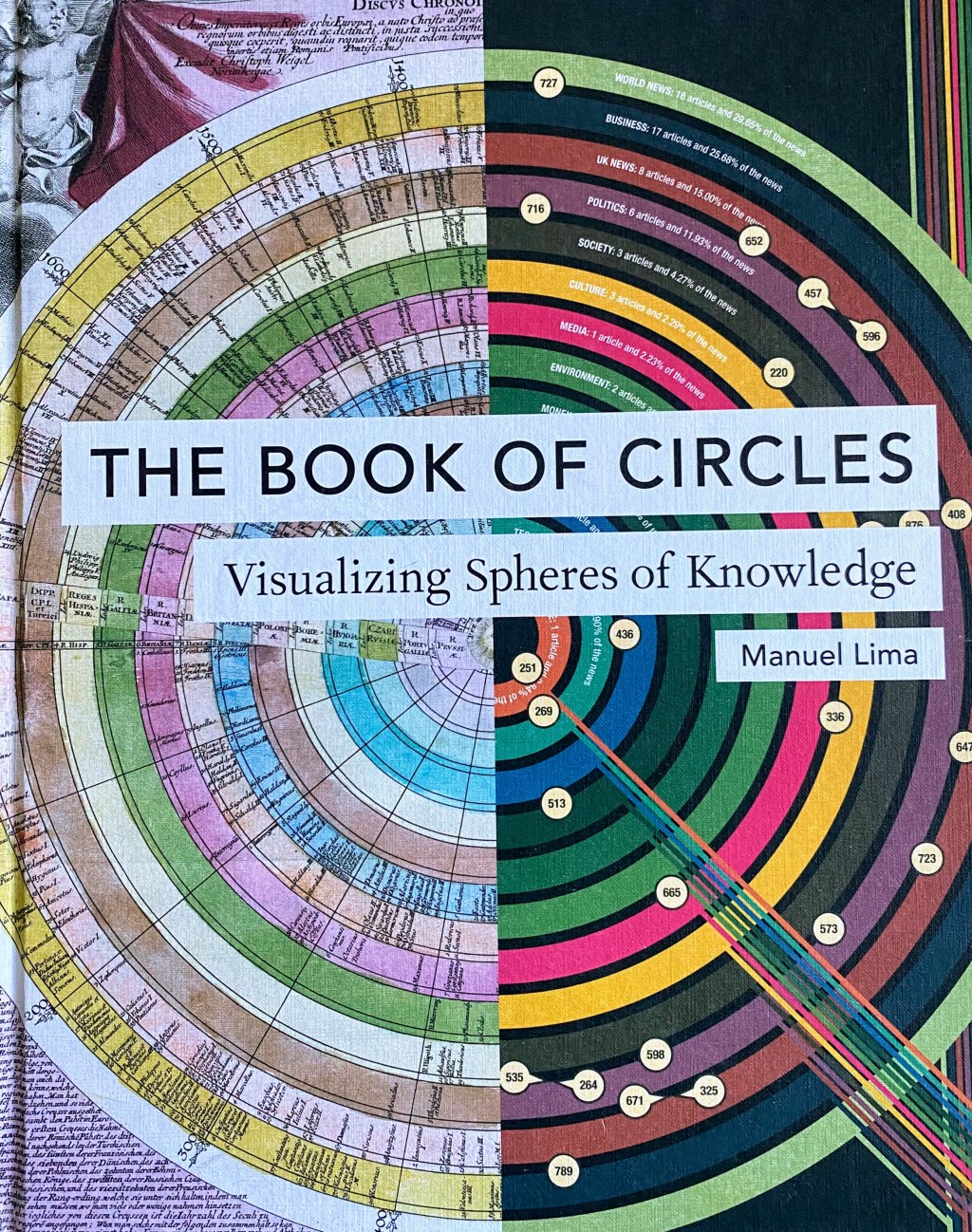
I have a lot of crochet stitch dictionaries. I really like collecting them because they are fun to look at and very educational for me. What they are not, always, is inspirational. I can look through and think I would like to work with a stitch pattern but what that stitch pattern will become often eludes me. This is where my collection of non-crochet books comes into my inspiration process. There are some books that are inspiring because of their beauty, the geometry of their illustrations, the colors used, or the images they bring to mind. I would like to share one of my favorites with you.
If you have never seen The Book of Circles by Manuel Lima, you are in for something awesome! This is a book of informational graphics. Yep. That’s it. For someone who hates math in all of its forms, this might be a surprising choice of inspiration books for me, but the sheer creativity of the diagrams carries the inspirational value of this book.
The book contains a brief and interesting history of the use of circular graph to convey data from the earliest maps of the earth and the cosmos to very, very complex maps of modern data transmission and representation and then lots and lots of examples. To be completely honest, I have no idea what many of these graphs even refer to, but it doesn’t matter. They can just sit and be beautiful and that is enough! I can imagine many of them as the basis for an awesome new project.
Allow me to tempt to with some very appealing and sexy graphs:

Geocentric Model
1549
The Book of Circles, page 68
This is an early depiction of the cosmos. I love that the earth is a little mud ball in the center surrounded by air and fire, in turn surrounded by darkening shades of deep space, or, I suppose, in this case, the stacked layers of the cosmos.
Imagine this as a circular shawl in a cream to indigo fade with a border of color-worked stars around the edge. Maybe you could pop little bits of a golden yellow color between the layers. You can cut or keep the earth and ring of fire, your choice. It’s inspiration, not a hard plan. Though I think a brown motif with a fiery border could make a cool center. If you are feeling particularly like tormenting yourself, work the constellations into the bands with sparkling beads. Make this for an astronomer, an astrologer, a star gazing friend, or someone who might just get lost in the universe in a tesser too far and need a nudge to find the way back home. The conversation starting potential of this shawl is enough to make this a worthy project.
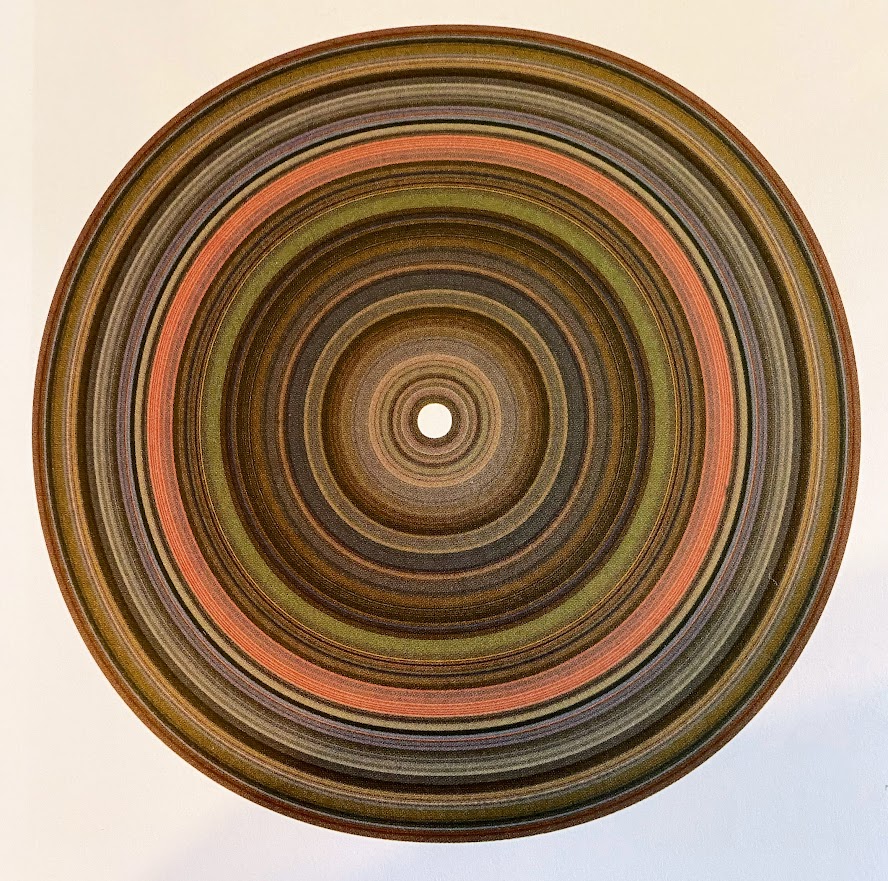
The Shining – A Visual Deconstruction
The Book of Circles, page 70
This ingenious graph looks at The Shining in terms of color, action, and timing. I don’t like horror movies, so I have never seen The Shining, and I am not drawn to these colors, but I love the overall effect. I’m thinking of this as a sweater yoke so you can strand the colors more easily, but you do your own thing. I’ve always wondered what it would look like to braid the loose ends along the side of a shawl or scarf instead of weaving them, maybe that could be the salvation of working a scarf with this sort of striping scheme. If you do it, send a picture.
Anyway, I love the little thin stripes and the way the whole thing almost radiates. Choose colors that bring you joy, pick one that really draws the eye (Is the pink bit supposed to represent blood in this diagram? Shudder. I hadn’t thought of that before and I wish I hadn’t now.), and switch colors as you work when the spirit moves you. Maybe not the spirits. Ignore those. They have nothing to add to this project. This is just about colors. Happy, soothing colors.

Peter Crnokrak
Maths Dreamed Universe
Book of Circles, page 88
This graph is a map of numbers in a logarithmic spiral. I do not know what that means. There’s something about angles and something about patterns and something about natural structures. I understand none of this and I am not going to stress myself to learn it. What I am going to envision is a tone and a shade of some scrumptious color worked in continuing bands swirling around each other to make a mesmerizing shawl, hat, or pair of mittens. To replicate the dots, you could work beads along some rows in a set pattern or you could work a taller stitch and leave gaps that could be filled with tiny motifs. Tiny as in one row of single crochets over a padded center, which has everything to do with showing off your skills at making padded centers. Or you could work puff stitches every so often. If you felt like suffering, you could work the puffs in a different color from the rest of the shawl. Maybe the whole thing could be tapestry? It would be stunning!
I don’t think you need to replicate the exact placement of the dots, in case that was something you were fearing. I think so long as you work in a pattern that you can remember, it will be fine. Of course, if you understand what this diagram is about and want to do that sort of math, please do. I guess someone needs to understand it, it just won’t ever be me.
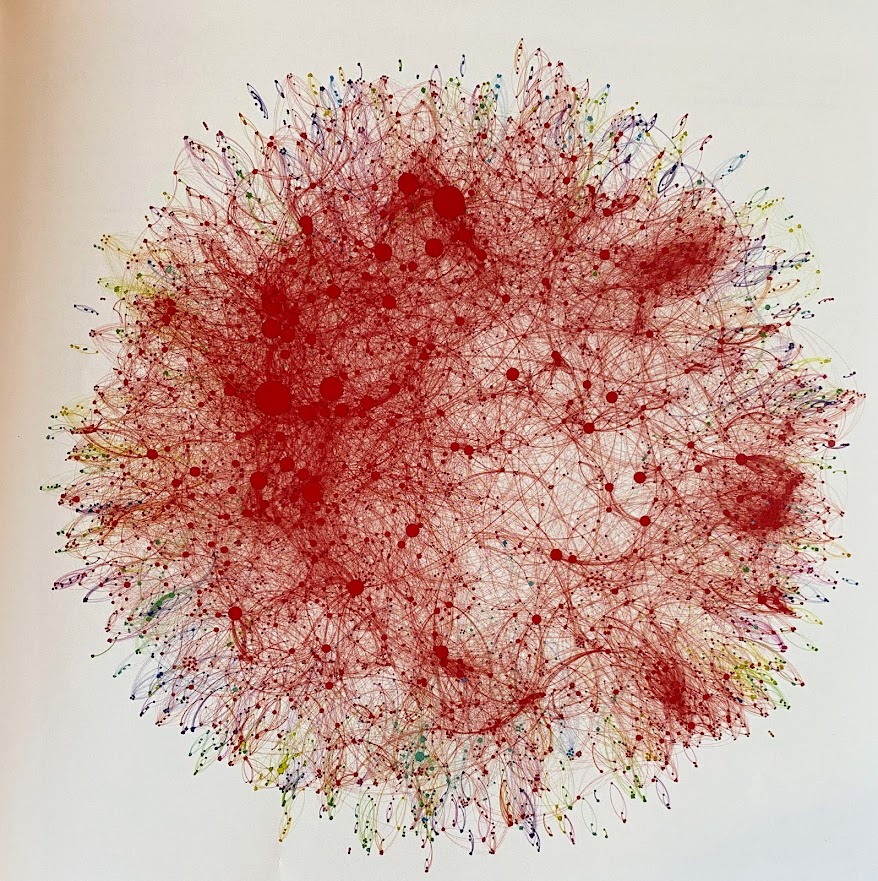
Co-Authorship relationships between physicians publishing on hepatitis c, 2008-2012
Book of Circles, page 251
This is a representation of collaborations among physicians publishing papers on hepatitis C. There are 8,500 circles. That is a disgusting number of ends if you went about creating such a thing in yarn. But imagine if you created a small mound, perhaps a large mound, of motifs, pinned them to fabric to keep them in place while you work, and then created lines of crocheted chains between them? When you unpin after connecting all of the dots and the fabric falls away, it would be breathtaking! Some motifs would be held on by a single line of chains. Others would be almost lost in a hub of activity. It would make a stunning capelet or skirt if you ever managed to weave in all those ends.
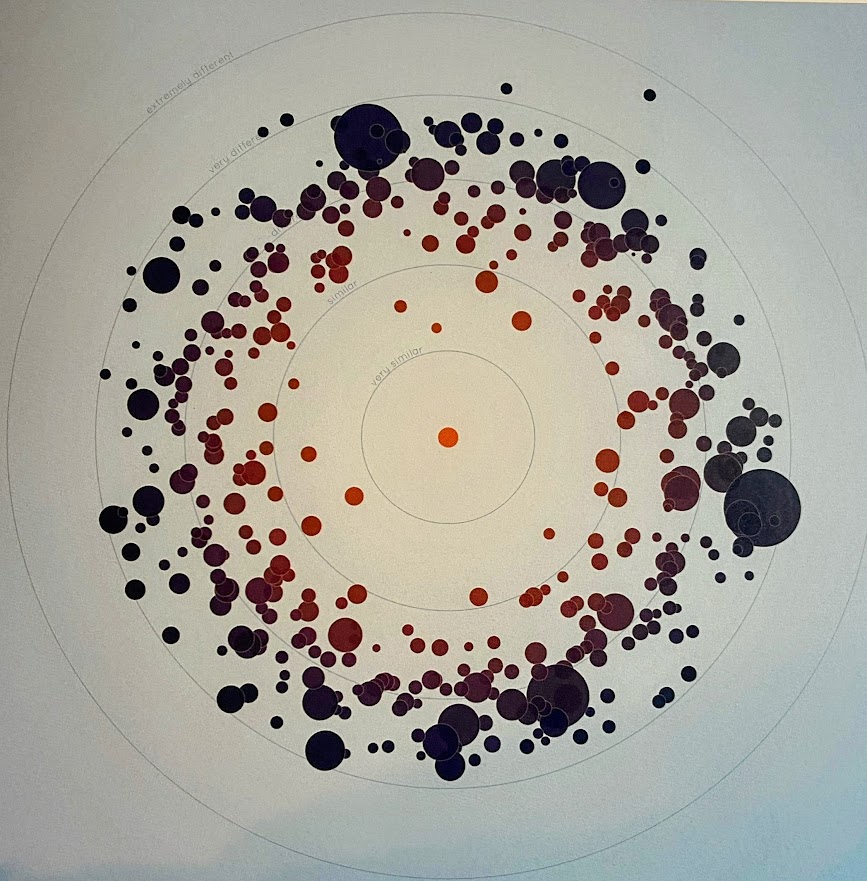
Close Votes
Book of Circles, page 181
This is an election analysis. I love the color choices as the dots fade from bright orange to deep purply blue. Imagine instead of showing election results it shows temperatures for the month of your birthday, the days leading up to Christmas, or some other personal event.
You make a basic shawl with a nice grid stitch and then fill it in with small motifs for each day’s temperature or other event for as many days as you want to cover. If you make the overall shawl biggish and the motifs small, you are going to have no problem creating a beautiful representation of your year. I recommend choosing contiguous colors instead of a wide range for a more cohesive look.
If you need more ideas on what to record, check out the book Dear Data for two artists’ interactions with each other as they record the minutiae of their lives through weird little charts and graphs. In this book, you will find plenty of other things to record that will possibly be more meaningful to you than temperatures, though recording the thermal demise of the planet does seem timely.

Circos
Book of Circles, page 136
This is from a tutorial about how to use Circos. Really. Whatever. It doesn’t matter. What fascinates me about it is the broken rings of colors. I can absolutely see this as a sweater, because you can strand the colors and no one but the wearer will ever see. It would be so much fun playing with all of those colors and not having to pay the end weaving gods.
You would need the perfect palette of colors. Perhaps pull them from Monet’s Waterlily series for a peaceful look. Or make it a celebration of your favorite colors. Or pull colors from a favorite book cover. Whatever you do, the colors are what will make this project amazing. It’s worth making them be about something.
OOOO! What if it was a temperature sweater!? That would be an awe inspiring thing. You could work a set number of stitches for each day and change colors as needed. Take that boring temperature blankets. If you go this route, maybe make up a plain colored sweater first that you could count the stitches on so you could divide them out nicely. You can work a little break of a few stitches between the days if that makes it clearer for you.
Given the look of the stripes in the original diagram, I think I would use a fairly solid stitch but something with an interesting texture so that the sweater had two points of interest that complimented each other. You could of course work it in all single, half-double, or double crochets, but where is the fun in that?
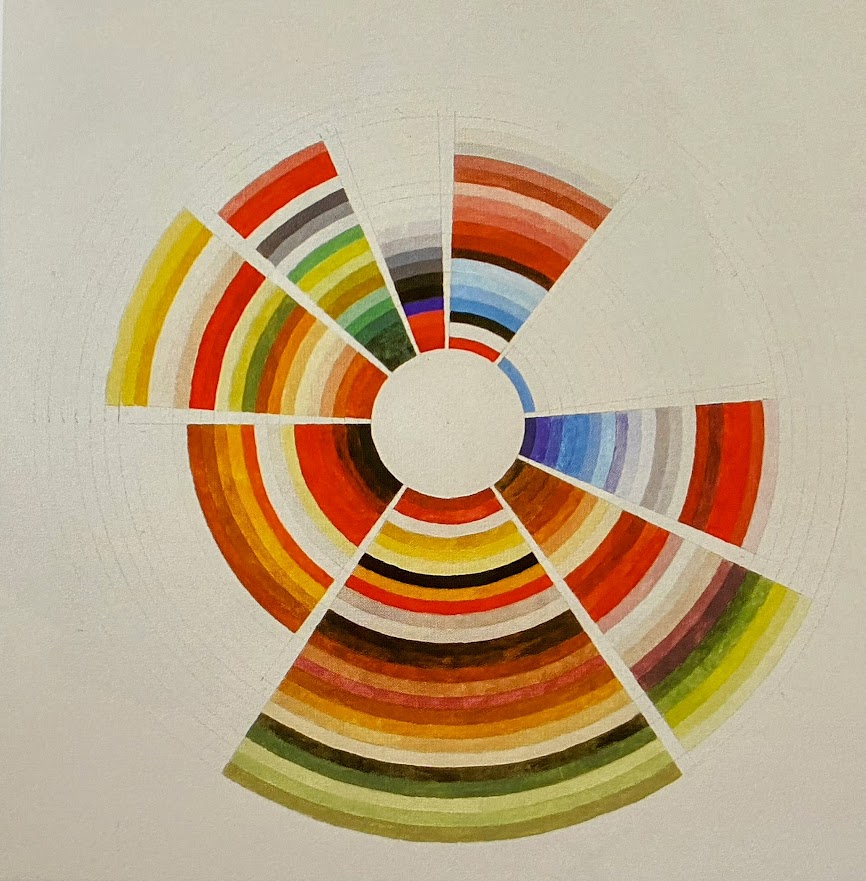
Circular Color Scheme: Target, June 27 – June 3, 2010, Page 1, “Pack Your Cooler With Savings”
Book of Circles, page 116
This is one of Richard Garrison’s paintings based on Target circulars. He pulls the colors from the circular and then figures out how much of each color to include using, wait for it, stupid math. We don’t have to be so horrid to ourselves. We can just take inspiration from the beauty of his work. Imagine a shawl or a sweater made of rows of stripes. The right color choices and the right way to join the strips of stripes and you have a head turning project.
Is it going to be all ends? Yes. Are you going to have to figure out the perfect way to join the strips so they don’t look clunky? Yes. For me, that might be strips of motifs between the strips of stripes. If I can find a way to add more ends, I’m going to take it every time.
I can see this project as a shawl or a skirt or a capelet or even a pair of mitts. It would be such a happy, colorful project it would be a joy to work, a joy to wear, and a joy to see in the closet. Once you get over the ends, of course.
I could even see it as a temperature shawl in which each month was 1/12 of a circle and each day was one stripe. To make the strips the same length, missing days from shorter months could be filled in with a nice neutral color. The trick would be figuring out the 1/12 of a circle thing. I guess if you used a stitch pattern based on double crochets, which add 12 stitches per increase row, you would be all set. Maybe work a pretty motif for the center that ended in a multiple of 12 and work the rows for the days off of that. That math seems straightforward. Must have done something wrong . . .
The book is full of so much more inspiration than I have shared here. I highly recommend giving it a look. If nothing else, you are going to see some impressive visualizations of data that remind us that artistic creativity does not lie only with the visual artists. Go see what the math nerds are doing. It’s entirely worth the effort.
If you attempt working any of these nuggets of inspiration into a crochet project, let me know. I would love to see what you do. If there is one you would particularly like to see me work into a pattern and then write up my notes for, drop it in the comments, and I’ll give it a try.
Happy crafting and keep looking for inspiration in the weirdest places!

 Cat Mad Crochet
Leave a comment