Estimated reading time: 7 minutes
I am one step closer to my ultimate goal of owning all of the crochet stitch dictionaries! Someday, people will come and study at the “Catherine Madjaric Library of Crochet Stitch Dictionaries”. This will be my legacy!
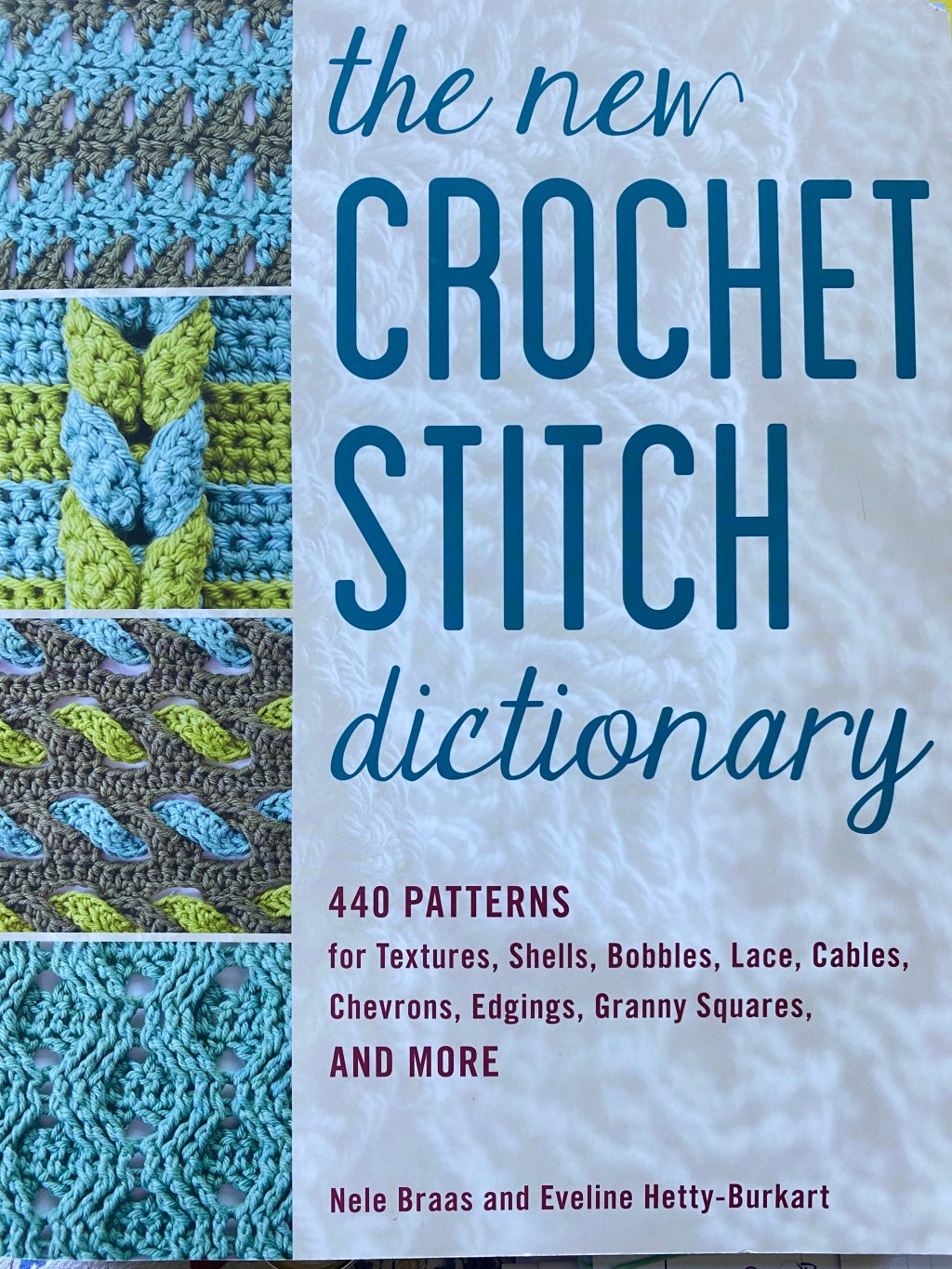
My latest acquisition is The New Crochet Stitch Dictionary, which was first published in German as Häkelmuster, by Nele Braas and Eveline Hetty-Burkart. Dictionaries from foreign countries are one of my favorite things. It’s really interesting to see how crafters in other countries group and describe stitches, let alone see what stitch magic they are getting up to. The internet makes these differences much smaller, but there are still differences and they fascinate me. So a German stitch dictionary reprinted in English for those of us whose German is sehr schlecht is a wonderful thing.
The New Crochet Stitch Dictionary is everything I am looking for: There are lots of patterns (440), it’s not granny square heavy (only 23 patterns); there are very few designs calling out to be tablecloths (looking at you pineapple lace, how do you get everywhere?); there are stitches pictured worked flat and in the round (eliminating a step in deciding to turn rounds or not); there are lots of interesting solid patterns (great for designing Adia’s sweaters); and there are lots of interesting lace patterns (perfect for Hannah’s sweaters). Then there’s the index!
Yes! I know what I said. The index is a glorious piece of helpfulness and information. There have been many times in my design process when I have found myself searching for a stitch pattern that has a set number of stitches in the repeat and a number I can either meet or fudge for the extra stitches necessary to complete the pattern. This brilliant index lists the patterns under their chapter headings for easy stitch type reference and then gives the number of stitches in a repeat, the stitches needed to complete the pattern, and the number of chains in a turning chain. I no longer need to leaf through books looking for a stitch pattern with the right number of stitches as the light of an exciting new project slowly dims when the perfect stitch fails to materialize. Thank you to the writers for this index! Brilliant!
The book is divided into the following chapters:
*Basic Stitch Patterns (69 patterns)
*Shells and Fan Patterns (49 patterns)
*Clusters, Popcorns, Bobbles, Puffs, and Nupps (57 patterns)
*Spike Stitch Patterns (29 patterns)
*Raised Stitch Patterns (35 patterns)
*Mesh and Trellis Patterns (50 patterns)
*Crossed and Interlocking Stitches, Cables (44 patterns)
*Ripple and Chevron Patterns (39 patterns)
*Edgings and Borders (44 patterns)
*Granny Squares (23 patterns)
It’s heaviest on the types of stitches I like best: Modern looking laces with texture and interest that don’t look like tablecloths. These represent the bulk of the patterns, even considering pineapple lace’s ever presentness. (I know it takes a lot of counting and care to make good pineapple lace. I understand that to make it pop you need to also use the right yarn and hook size and then bring it all together with the proper blocking to make it look like a well made tablecloth. I just don’t like pineapple lace.)
There’s a lot of potential to add post stitches to the laces presented here to give them a little more textural interest, but even without that the stitch patterns presented are visually dynamic and call out to be manipulated into sweaters and scarves and fingerless gloves and other magical things. This book could soon find itself in with my favorite stitch dictionaries. It has already sprouted an array of post-it notes sticking out of the pages and my notes on how to increase and decrease stitch patterns paperclipped to various patterns.
Behold the little wrap I started with the “Lattice with Little Bells” stitch!

It’s light and happy and textural! I meant to make it more textural by adding some post stitches, but I utterly forgot because I started it late one night on a whim of inspiration and little thought. Next time, though, post stitches. I’ll have to write that down . . .
Spoiler: I plan to use this wrap as a swatch for a coming sweater. Stay tuned!
There are some innovative cables, including several that involve separately formed cables allowing them to be worked in different colors without having to do tapestry or stranding. Cables are very difficult for me, so the idea that there is another way to form them is really exciting and I look forward to playing with this part of the book. I may even try some traditional cables if I am feeling particularly like torturing myself.
The stitch patterns the authors present and the marvelous index are not the only selling points of this book. Not at all! The crocheted examples are perfectly blocked and executed in a yarn that holds the stitches and makes them sharp and readable. I have far too many stitch dictionaries in which the samples are made with a yarn that was loosely plied to begin with, exacerbated by being used for crochet, which tends to loosen the ply of s twist yarn and then, on top of that, poorly blocked. It just kills me! If there are bad samples and a diagram, I can at least get a sense of the pattern from the diagram, but with no diagram and bad samples, all is lost unless I sit down and make a swatch. This book exceeds all expectations, or, rather, no, it goes beyond that. This book meets my exceedingly high expectations for how a stitch dictionary should look: If you know what you are doing, you should be able to read the sample like you would read a stitch diagram. With this book, you can. I could not find a listing for what yarn they used, but I’m thinking it must be a cotton or a cotton blend based on how sharp the stitches are. This book shall have a golden light shining upon it in my stitch dictionary study center someday so that all the other books can see perfection.
Does this book have a downside? There are three items. First, the directions are not the row by row, stitch by stitch directions you normally see in a stitch dictionary. I’m fine with this. I bring it up only to let you know that the written directions are more a general guideline than specific directions. If you cannot read a chart, this book is not for you. The chart is the main form of directions with a few written comments to guide and explain the tricky bits.
The second is entirely a personal preference for me. It’s the chapter entitled “Clusters, Popcorns, Bobbles, Puffs, and Nupps”. I didn’t even know what a nupp was until I looked through this book. They are a sort of cone bobble that can be used alone or with other textural elements. You can even combine a nupp with a standard bobble to create what I can only think of as a nupple. It looks like it sounds. Bobbles, nupps, and popcorns are not for me. If you like them, there is a diverse chapter with 57 different questionably tasteful patterns.
The third item is again a personal preference. I don’t like ripple patterns. I think they all look like afghans no matter what you are making out of them. Despite my dislike for them, I can tell you that this book has a nice group of 39 different ripple and chevron patterns ranging from granny stitch ripples to ripple meshes and bobbles and other intricacies. If ripples are your thing, I think you will like this chapter.
I love this stitch dictionary. It would make a great find for anyone interested in more modern looking patterns that use texture and lace to create visual interest. Reading diagrams is a must to get the most from this book. If you can’t yet, it’s worth learning. If you get yourself a copy, take time to appreciate the index.

 Cat Mad Crochet
Leave a comment