Estimated reading time: 5 minutes
Geometry was not a good subject for me in high school. It was going alright until the poor teacher went and had a heart attack, so the class ended up with a substitute who was more interested in letting the guys in our class know what videos and games were just in at his video rental business than making sure the rest of us understood geometry. Left to my own devices, I did not learn geometry. I think this was a given. What I did instead with my class time was to decide which triangles were valid in my world and which ones were questionable. My 15 year old self was right about triangles, even if I was wrong about so much else. Now those ideas are playing out in my crochet.
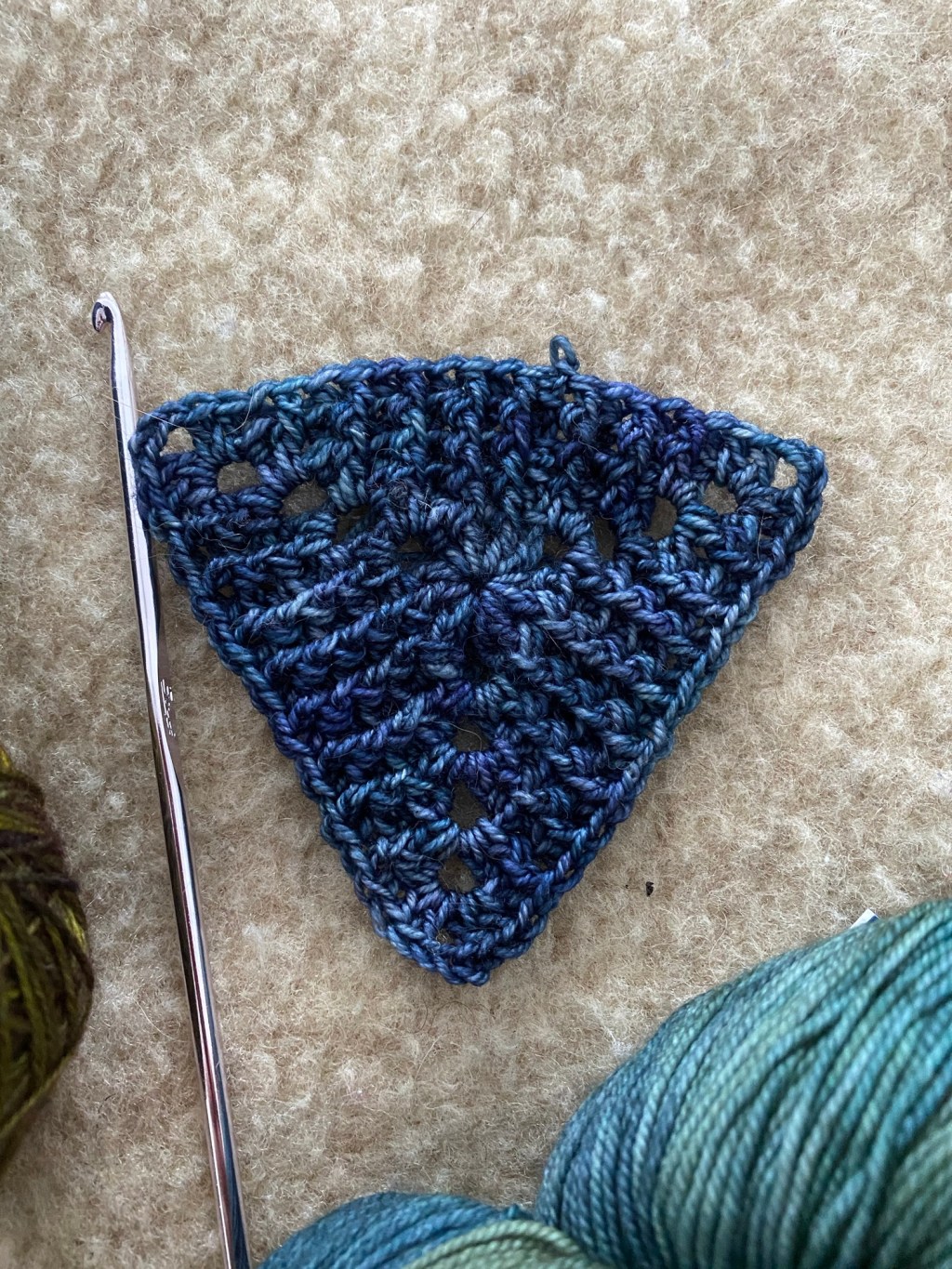
If you remember from your days in the world of geometry, there are three types of triangles. First you have equilateral triangles with three equal sides and angles. These are the sexiest of triangles. There’s just something perfect about them. They tessellate with ease. You can create hexagons, kites, stars, larger triangles, and complex color patterns. Lovely! Perfect!
I enjoy working with equilateral triangle motifs. I can use them just as triangles or go on to create all sorts of other shapes. Maybe they aren’t as good for overall project shapes, but I still love them. Perhaps it’s their perfect symmetry? Perhaps it was the ease with which I could answer the question: What are the lengths of the other sides if side A is 6? Perhaps it was always knowing immediately that the angles are all 60 degrees in every equilateral triangle forever.

The next triangle we will drag from our high school memory vaults is the isosceles triangle. Pulling it up again, I realize I still can’t spell it, so we’re already on shaky ground. These little buggers are more complex. Two sides and two angles are the same and one side and one angle are different. Why? Because they like being difficult, I think.
Despite these clear failings, isosceles triangles do have some interesting uses as a motif. For instance, you can build squares out of them. This is pleasant because squares are awesome. You can also make kites and rhombuses and trapezoids. You can even create the triangles themselves in different ways: They can be right triangles or have one obtuse angle and two acute angles or three angles that are closer together in size but not quite the same. Basically you can make short squat triangles or tall thin triangles or half square triangles. Isosceles triangles are versatile and fun as motifs but also as overall project shapes. The long, thin, dramatic triangle wraps that Hannah favors are nothing but isosceles triangles and those are fun both to make and to wear.

Last, and definitely least, we have scalene triangles. Everything they do they do on purpose and out of maliciousness. This triangle, in its right triangle form, lives for the Pythagorean theorem. They just love each other. I hate them both. Scalene triangles have no two sides the same length and no two angles the same size. As motifs, they tessellate in ways that make other odd shapes. I, for one, do not wish to make anything out of parallelograms, and, while scalene triangles make very nice parallelograms, they are not for me. When it comes to motifs, give me the happy, simple symmetry of an equilateral triangle over these scalene monsters any day.

As a finished shape, though, scalene triangles come into their own. Given the squirrelly nature of this type of triangle, you can make a triangle with one short side and two very long sides. If you wanted to thread the long end through the short end to create a capelet sort of thing out of a flat, triangular wrap, scalene triangles will be your shape of choice. You could stitch two scalene triangles together to make a long, dramatic, almost boomerang shaped shawl. This ability to make interesting finished shapes is the scalene triangle’s only redeeming feature. I said it and I meant it. No more Pythagorean theorems for me. And yes, I know you can use them with isosceles triangles, too. I’m just in denial. (I also understand that other triangles can be used to make parallelograms. I paid some attention in geometry despite what my test scores indicate.)
But seriously, triangles are a lot of fun. Their geometry can be a lot but I think dredging up some of that forgotten high school knowledge to re-learn how to manipulate triangles to do our bidding is a good thing. We can play with triangles freely in a fuzzy, crocheted world in which no one cares what length the third leg of a triangle with sides of 5 and 11 and angles of 48 and 23 might be. We can find fun ways to play with crochet and make new and exciting designs for both finished project shapes and motifs with triangles of all forms. Just leave the proofs in the dustbin of high school.
Happy crafting!

 Cat Mad Crochet
Leave a comment