Estimated reading time: 2 minutes
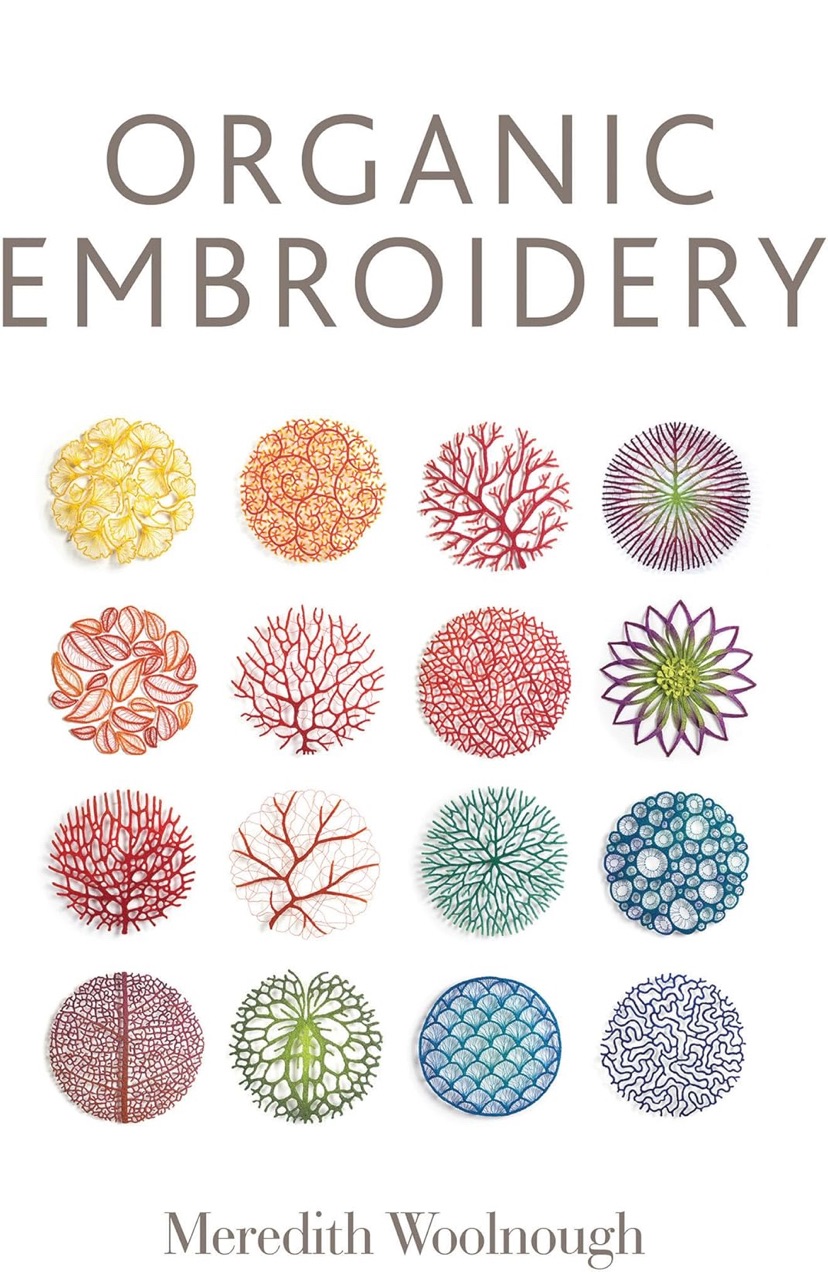
Organic Embroidery by Meredith Woolnough is a seriously fun book filled with nature inspired designs. Woolnough works in thread and sews her designs on to water soluble stabilizer paper, which is then dissolved away, leaving open designs that call to mind the sea and nature.

Because some of her work resembles crochet motifs, it makes me look at crochet motifs in new ways. Specifically, how can motifs be used as building blocks for forms instead of just pieces of a flat arrangement? I know there are balls and bowls out there made of crochet motifs, but those motifs are always solid. What if we used the open, lacy motifs instead? What if we worked them in thread and then starched them stiff to hold their forms? Sort of like the balloon, starch, and thread constructions my grandmother used to make? The motifs could overlap or they could be very carefully crafted to fit together just so.
This piecing of balls sounds straightforward, but it isn’t. Jinny Beyer wrote a book about making balls with quilt blocks. (Patchwork Puzzle Balls-It’s really informative and interesting and aesthetic. I highly recommend it.) Apparently the angles one needs to connect shapes when flat are different from the angles one needs to connect shapes in the round. Of course they are. The little monsters.
So creating tiled crochet motif balls would require some serious math work that would make me switch crafts, so if I ever attempt to make lacy crochet motif balls, those motifs are going to be overlapping. Just saying.

Woolnough’s art also makes me want to try to recreate the microscopic structures of wood in a freeform yarn creation. Take this image of a tulip tree from the Harvard Arboretum:

Now imagine this as a shawl! It would be stunning worked in a tightly spun single ply lace weight yarn or in cotton thread.

Or tree rings! Imagine tree rings worked in consecutive layers of laces and some sort of carefully thought colorway. It would be stunning! It would also be a masterclass in increasing with different stitch heights in each row in a single project, but what fun is a project if it doesn’t make you learn new skills? Why they are so often math based skills, I don’t know, but here we are.

Woolnough’s work is stunning on its own and well-worth getting a nice cup of tea and taking the time to slowly peruse. But its second value for fiber artists is to sit with it and let your mind wander with your own work, finding new paths to creation.
This title is available online but, oddly, was not available at my local library. Go figure. The library patrons are really missing out on this one.

 Cat Mad Crochet
Leave a comment