Estimated reading time: 5 minutes
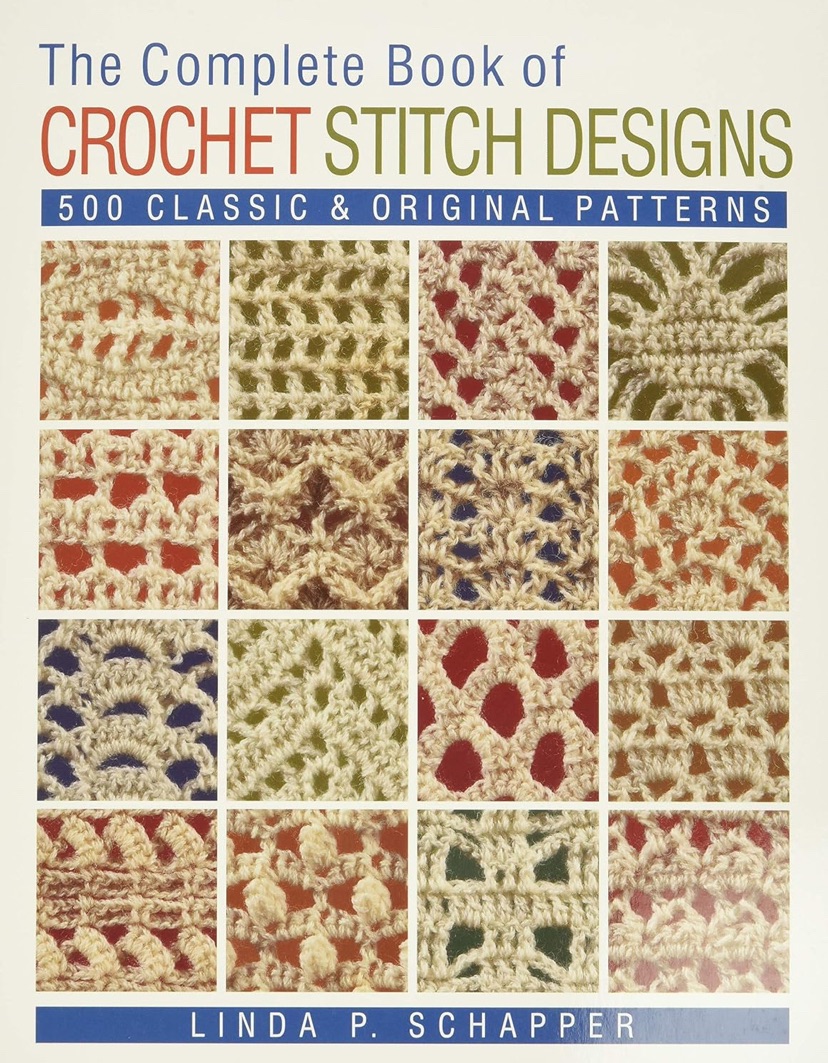
Let’s talk about The Complete Book of Crochet Stitch Designs by Linda P. Schapper. This book was first published in 1985 (when I was but 12 and only knew passingly of crochet) and was re-released with updates in 2007 (when I was much older and only just beginning to crochet). With 500 stitches, most of which are lace or open stitches, there is something in this book for almost everyone, from people making cool sweaters and interesting wraps to people who want to make tablecloths. Yes, oh my faithful reader, pineapple lace is included in this book. I know pineapple lace is good for more than tablecloths, I just don’t like it.
In her introduction, Schapper discusses making updates to her original text that included the need to remake some of the blocks from her original publication because the original blocks, and their photographs, had been lost. So what can we infer from this? I’m betting the yarn she used for the swatches in the first publication wasn’t the greatest. Everything I’ve read tells me that the yarns we use now are better than those available in the 1980s because of improvements in technology and fiber availability and market demand. Why do I bring this up? Because I think the yarn used for these samples, which is never identified in the book, is a bit of an odd choice. Perhaps it wasn’t odd for the 1980s, but now it does seem off, at least to my eye. This is in part because it makes the book look dated, but also because this particular yarn fails the stitches themselves.
For example, this is an image from The Complete Book of Crochet Stitch Designs:

And here is an image of a similar stitch from The New Crochet Stitch Dictionary:

Clearly there is a big visual difference between the two pictures; however, yarn choice makes a difference in more than just the look of the swatch. A sharp, crisp yarn is going to yield sharp, crisp, visually understandable stitches. We don’t really see that in Schapper’s book. The stitches, like the yarn, are a bit soft and fuzzy resulting in hard to read pictures. Not only that, but the blocking seems a bit weak sometimes. A stronger blocking on some of the lace patterns would have opened them up better and made them more understandable.
Fortunately, there are stitch diagrams (and traditionally written instructions) included with every single sample, so we can get a good sense of what is happening from those even if the actual swatch is unclear. I don’t think the original publication had diagrams and, given that some of the photos were from that publication, I’m not sure how useful that book would have been to me or anyone needing a clear, strong, visual image of a stitch pattern. The diagrams help clear up what the fuzzy, soft yarn obscures, so adding them was almost a necessity.
All that being said, I like when books provide both the written instructions and diagrams, as the author does here. It’s more inclusive for potential readers, but it also gives people a second resource if one or the other has an error. So if you are one for written directions or diagrams, this book has you covered.
The written instructions are nicely done, too. Between the block of instructions for each row is a line to separate the blocks of text which makes each row’s instructions clearer and easier to follow. The notation is traditional crochet notation, so if that’s not your thing, stick with the diagrams, but if you like written instructions, effort has been made to make them clear and readable.
So what is in this book? There are 500 open and lace stitch patterns, with a few solid stitches thrown in, spread over 33 chapters divided by the predominant type of stitch used for each pattern. It looks like this:
Single crochet – 3 stitch patterns
Single crochet and chains – 7 stitch patterns
Double crochet and chains – 15 stitch patterns
Single crochet, double crochet, and chains – 44 stitch patterns
Treble crochet, double crochet, single crochet, and chains – 7 stitch patterns
V-stitches – 11 stitch patterns
Simple shells – 8 stitch patterns
Shells–filet – 10 stitch patterns
Shells–symmetrical – 26 stitch patterns
Shells–overall patterns – 20 stitch patterns
Shells and chains – 20 stitch patterns
Shells–staggered – 8 stitch patterns
Shells–small lace patterns – 17 stitch patterns (including pineapple)
Shells–fantail – 4 stitch patterns
Shells–treble crochet – 2 stitch patterns
Shells–large lace patterns – 8 stitch patterns
Clusters – 13 stitch patterns
Clusters–inverted shells – 13 stitch patterns
Wraparound stitches – 8 stitch patterns
Staggered squares – 12 stitch patterns
Y–stitches – 3 stitch patterns
X–stitches and crossed stitches – 17 stitch patterns
Picots – 29 stitch patterns
Bobbles – 32 stitch patterns
Puff stitches – 32 stitch patterns
Puff stitch combinations – 29 stitch patterns
Popcorn stitches – 11 stitch patterns
Dropped stitches – 15 stitch patterns
Post stitches – 37 stitch patterns
Horizontal stripe patterns – 8 stitch patterns
Vertical columns – 19 stitch patterns
Multi–stitches – 5 stitch patterns
Miscellaneous – 4 stitch patterns
Given the number of stitch patterns in this book, I think arranging them by predominant stitch type makes a lot of sense, but to make it even easier, there is a thumbnail style guide at the front of the book as a quick reference to finding your perfect stitch.
The strength of this book lies in the number of stitch patterns it presents. The patterns presented are mostly lace or open stitches with some, but not a lot of, textural stitches. The stitches presented are not overly complex but many do look impressive without requiring you to work in a silent room while your family is under threat of dismemberment if they disturb your counting. I think there is a lot here to offer for the crocheter interested in easy to work open stitch patterns.
This book is still in print and available rather widely. If you are able to overlook the fuzzy yarn and resultant unclear pictures of the swatches and want a big book of crochet stitches that are mostly lace and open stitches with both traditional notation and diagrams, this is your book.

 Cat Mad Crochet
Leave a comment